

Feast of the Transfiguration of Christ on Mount Tabor - August 6
2023 Schedule:
- Sat. Aug 5, 6:00pm - Festal Great Vespers with Litya
- Sun. Aug. 6, 9:10am - Hours and Divine Liturgy
- followed by Blessing of Fruit Baskets
Scroll down for special articles on the Transfiguration...

Light on the Mountain:
Greek Patristic and Byzantine Homilies on the Transfiguration of the Lord
St Vladimir's Seminary Press, Popular Patristics Series Volume 48
Translated by Brian E. Daley, S.J.
The episode of the Transfiguration of Jesus plays a key role in the narrative of the Synoptic Gospels. Peter and his fellow Apostles have just acknowledged Jesus to be Israel’s long-awaited Messiah, and have been shocked by Jesus’ immediate prediction of his coming passion and death. Now Peter, James and John are allowed to share an extraordinary vision, marking him out as truly God’s own Son, radiant with divine glory. Early Christian commentators and preachers recognized the crucial importance of this incident for Christian faith and discipleship, as pointing in advance to the power of the cross and resurrection of Christ. The liturgical feast of the Transfiguration, anticipating that of the Exaltation of the Cross by forty days, came to be celebrated in the Eastern and Western Churches, beginning in the seventh century; yet since at least the third century, theologians have reflected on the significance of this event for the life of faith.
This volume brings together, in a new translation, a comprehensive collection of homilies on the Transfiguration of Christ from the Greek Patristic and Medieval Church, from Origen in the third century to St. Gregory Palamas in the fourteenth. Together they form a profound and moving set of meditations, from many perspectives and in many voices, on “the light of the recognition of the glory of God in the face of Christ” (II Cor 4.6), and on its importance for our lives.
Brian E. Daley, S.J., is the Catherine F. Husking Professor of Theology at the Univeristy of Notre Dame and also the translator of On the Dormition of Mary: Early Patristic Homilies (PPS18).
Visit SVS Press for the full Table fo Contents and to order.

Dear Parish Faithful,
“Thou was transfigured on the mount, O Christ God”
"The light of the Transfiguration, foreshadows not only Christ’s own Resurrection on the third day, but equally the Resurrection glory of the righteous at His Second Coming. The glory which shone forth from Jesus on Tabor is a glory in which all mankind is called to share. On Mount Tabor we see Christ’s human nature –the human substance which he took from us – filled with splendor, ‘made godlike’ or ‘deified.’ What has happened to human nature in Christ can happen also to the humanity of Christ’s followers. The Transfiguration, then, reveals to us the full potentiality of our human nature: it shows us the glory which our manhood once possessed and the glory which, by God’s grace, it will recover at the Last Day."
(The Festal Menaion, p. 62)
|
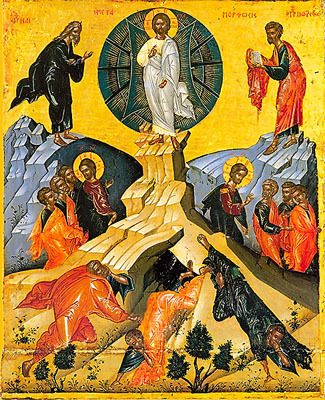
Icon from Dionysiou Monastery, Mt Athos |
On the sixth day of this month we commemorate the Divine Transfiguration of our Lord, God, and Savior Jesus Christ.
Verses
Tabor was glorified above every region of the earth,
When it beheld the nature of God shining in glory.
Christ changed His human form on the sixth.
St Nikolai Velimirovich
Why was our Lord transfigured on a mountain and not in a valley? So as to teach us two virtues: love of labor and godly-thoughts. For, climbing to the heights required labor and height represents the heights of our thoughts, i.e., godly-thoughts.
Why was our Lord transfigured at night? Because, the night rather than the day is more suitable for prayer and godly-thoughts and because the night, by its darkness, conceals all the beauty of the earth and reveals the beauty of the starry heavens.
Why did Moses and Elijah appear? In order to destroy the error of the Jews, as though Christ is one of the prophets; Elijah or Jeremiah or some other that is why He appears as a King above the prophets and that is why Moses and Elijah appear as His servants. Until then, our Lord manifested His divine power many times to the disciples but, on Mt. Tabor, He manifested His divine nature. This vision of His Divinity and the hearing of the heavenly witness about Him as the Son of God, should serve the disciples in the days of the Lord's passion, in strengthening of an unwavering faith in Him and His final victory.
You were transfigured on the Mount, Christ God revealing Your glory to Your disciples, insofar as they could comprehend. Illuminate us sinners also with Your everlasting light, through the intercessions of the Theotokos. Giver of light, glory to You.
Kontakion in the Grave Tone
You were transfigured upon the mount, O Christ our God, and Your disciples, in so far as they could bear, beheld Your glory. Thus, when they see You crucified, they may understand Your voluntary passion, and proclaim to the world that You are truly the effulgence of the Father.

by Fr. Thomas Hopko
The Transfiguration of Christ is one of the central events recorded in the gospels. Immediately after the Lord was recognized by his apostles as “the Christ [Messiah], the Son of the Living God,” he told them that “he must go up to Jerusalem and suffer many things ... and be killed and on the third day be raised” (Mt 16). The announcement of Christ’s approaching passion and death was met with indignation by the disciples. And then, after rebuking them, the Lord took Peter, James, and John “up to a high mountain”—by tradition Mount Tabor—and was “transfigured before them.”
... and his face shone like the sun, and his garments became white as snow and behold, there appeared to them Moses and Elijah, talking with him. And Peter said to Jesus, “Lord, it is well that we are here; if you wish I will make three booths here, one for you and one for Moses and one for Elijah.”
He was still speaking when lo, a bright cloud overshadowed them, and a voice from the cloud said, “This is my Beloved Son, with whom I am well pleased; listen to him.”
When the disciples heard this, they fell on their faces with awe. But Jesus came and touched them, saying, “Rise, and have no fear.” And when they lifted up their eyes, they saw no one but Jesus only.
And as they were coming down the mountain, Jesus commanded them, “Tell no one the vision, until the Son of Man is raised from the dead” (Mt 17:1-92, see also Mk 9:1-9; Lk 9:28-36; 2 Peter 1:16-18).
The Jewish Festival of Booths was a feast of the dwelling of God with men, and the transfiguration of Christ reveals how this dwelling takes place in and through the Messiah, the Son of God in human flesh. There is little doubt that Christ’s transfiguration took place at the time of the Festival of Booths, and that the celebration of the event in the Christian Church became the New Testamental fulfillment of the Old Testamental feast in a way similar to the feasts of Passover and Pentecost.
In the Transfiguration, the apostles see the glory of the Kingdom of God present in majesty in the person of Christ. They see that in him, indeed, all the fullness of God was pleased to dwell,” that “in him the whole fulness of deity dwells bodily” (Col 1:19, 2:9). They see this before the crucifixion so that in the resurrection they might know who it is who has suffered for them, and what it is that this one, who is God, has prepared for those who love him. This is what the Church celebrates in the feast of the Transfiguration.
Thou wast transfigured on the mount. O Christ God, revealing Thy glory to Thy disciples as they could bear it. Let Thine everlasting light shine upon us sinners. Through the prayers of the Theotokos, O Giver of Light, glory to Thee (Troparion).
On the mountain wast Thou transfigured, O Christ God, and Thy disciples beheld Thy glory as far as they could see it; so that when they would behold Thee crucified, they would understand that Thy suffering was voluntary, and would proclaim to the world that Thou art truly the Radiance of the Father (Kontakion).
Besides the fundamental meaning which the event of the Transfiguration has in the context of the life and mission of Christ, and in addition to the theme of the glory of God which is revealed in all of its divine splendor in the face of the Saviour, the presence of Moses and Elijah is also of great significance for the understanding and celebration of the feast. Many of the hymns refer to these two leading figures of the Old Covenant as do the three scripture readings of Vespers which tell of the manifestation of the glory of God to these holy men of old (Ex 24:12-18; 33:11-34:8; 1 Kings 19:3-16).
Moses and Elijah, according to the liturgical verses, are not only the greatest figures of the Old Testament who now come to worship the Son of God in glory, they also are not merely two of the holy men to whom God has revealed himself in the prefigurative theophanies of the Old Covenant of Israel. These two figures actually stand for the Old Testament itself: Moses for the Law and Elijah for the Prophets. And Christ is the fulfillment of the Law and the Prophets (Mt 5:17).
They also stand for the living and dead, for Moses died and his burial place is known, while Elijah was taken alive into heaven in order to appear again to announce the time of God’s salvation in Christ the Messiah. Thus, in appearing with Jesus on the mount of Transfiguration, Moses and Elijah show that the Messiah Saviour is here, and that he is the Son of God to whom the Father himself bears witness, the Lord of all creation, of the Old and New Testaments, of the living and the dead. The Transfiguration of Christ in itself is the fulfillment of all of the theophanies and manifestations of God, a fulfillment made perfect and complete in the person of Christ. The Transfiguration of Christ reveals to us our ultimate destiny as Christians, the ultimate destiny of all men and all creation to be transformed and glorified by the majestic splendor of God himself.
There is little doubt that the feast of the Transfiguration of Christ belonged first to the pre-Easter season of the Church. It was perhaps celebrated on one of the Sundays of Lent, for besides certain historical evidence and the fact that today Saint Gregory Palamas, the great teacher of the Transfiguration of Christ, is commemorated during Lent, the event itself is one which is definitely connected with the approaching death and resurrection of the Saviour.
... for when they would behold Thee crucified, they would understand that Thy suffering was voluntary (Kontakion).
The feast of the Transfiguration is presently celebrated on the sixth of August, probably for some historical reason. The summer celebration of the feast, however, has lent itself very well to the theme of transfiguration. The blessing of grapes, as well as other fruits and vegetables on this day is the most beautiful and adequate sign of the final transfiguration of all things in Christ. It signifies the ultimate flowering and fruitfulness of all creation in the paradise of God’s unending Kingdom of Life where all will he transformed by the glory of the Lord.

The disciples saw also Moses and Elijah talking with our Lord, and thereby they understood that He was not Himself Elijah or another of the prophets, as some thought, but someone much greater: He Who could call upon the Law and the Prophets to be His witnesses, since He was the fulfillment of both.
The three parables of the feast concern the appearance of God to Moses and Elijah on Mount Sinai, and it is indeed appropriate that the greatest God-seers of the Old Testament should be present at the glorification of the Lord in His New Testament, seeing for the first time His humanity, even as the disciples were seeing for the first time His Divinity.
The Transfiguration, counted by the Church as one of the “Twelve Great Feasts,” had an important place in the Church calendar already in the fourth century, as the homilies and sermons of such great Fathers as Saint John Chrysostom, Saint Ephraim the Syrian, and Saint Cyril of Alexandria attest; its origins go back to the first Christian centuries. In the fourth century also, Saint Helena erected a church on Mount Tabor, the traditional site of the Transfiguration, dedicated to the Feast. Although the event celebrated in the Feast occurred in the month of February, forty days before the Crucifixion, the Feast was early transferred to August because its full glory and joy could not be fittingly celebrated amid the sorrow and repentance of Great Lent. The sixth day of August was chosen as being forty days before the Feast of the Exaltation of the Cross (September 14th, old style), when Christ’s Passion is again remembered.
Orthodox theology sees in the Transfiguration a prefigurement of our Lord’s Resurrection and His Second Coming, and more than this – since every event of the Church calendar has an application to the individual spiritual life – of the transformed state in which Christians shall appear at the end of the world, and in some measure even before then. In the foreshadowing of future glory which is celebrated in this Feast, the Holy Church comforts her children by showing them that after the temporary sorrows and deprivations with which this earthly life is filled, the glory of eternal blessedness will shine forth; and in it even the body of the righteous will participate.
It is a pious Orthodox custom to offer fruits to be blessed at this feast; and this offering of thanksgiving to God contains a spiritual sign, too. Just as fruits ripen and are transformed under the action of the summer sun, so is man called to a spiritual transfiguration through the light of God’s word by means of the Sacraments. Some saints, (for example – Saint Seraphim of Sarov), under the action of this life-giving grace, have shone bodily before men even in life with this same uncreated Light of God’s glory; and that is another sign to us of the heights to which we, as Christians, are called and the state that awaits us – to be transformed in the image of Him Who was transfigured on Mount Tabor.